Thursday, January 6, 2011

Breeding

Ninety-five percent of bird species are socially monogamous. These species pair for at least the length of the breeding season or—in some cases—for several years or until the death of one mate. Monogamy allows for biparental care, which is especially important for species in which females require males' assistance for successful brood-rearing. Among many socially monogamous species, extra-pair copulation (infidelity) is common. Such behaviour typically occurs between dominant males and females paired with subordinate males, but may also be the result of forced copulation in ducks and other anatids.For females, possible benefits of extra-pair copulation include getting better genes for her offspring and insuring against the possibility of infertility in her mate. Males of species that engage in extra-pair copulations will closely guard their mates to ensure the parentage of the offspring that they raise.
Other mating systems, including polygyny, polyandry, polygamy, polygynandry, and promiscuity, also occur. Polygamous breeding systems arise when females are able to raise broods without the help of males.Some species may use more than one system depending on the circumstances.
Breeding usually involves some form of courtship display, typically performed by the male. Most displays are rather simple and involve some type of song. Some displays, however, are quite elaborate. Depending on the species, these may include wing or tail drumming, dancing, aerial flights, or communal lekking. Females are generally the ones that drive partner selection, although in the polyandrous phalaropes, this is reversed: plainer males choose brightly coloured females. Courtship feeding, billing and allopreening are commonly performed between partners, generally after the birds have paired and mated.

Resting and roosting

The high metabolic rates of birds during the active part of the day is supplemented by rest at other times. Sleeping birds often use a type of sleep known as vigilant sleep, where periods of rest are interspersed with quick eye-opening 'peeks', allowing them to be sensitive to disturbances and enable rapid escape from threats. Swifts are believed to be able to sleep in flight and radar observations suggest that they orient themselves to face the wind in their roosting flight. It has been suggested that there may be certain kinds of sleep which are possible even when in flight. Some birds have also demonstrated the capacity to fall into slow-wave sleep one hemisphere of the brain at a time. The birds tend to exercise this ability depending upon its position relative to the outside of the flock. This may allow the eye opposite the sleeping hemisphere to remain vigilant for predators by viewing the outer margins of the flock. This adaptation is also known from marine mammals. Communal roosting is common because it lowers the loss of body heat and decreases the risks associated with predators. Roosting sites are often chosen with regard to thermoregulation and safety.
Many sleeping birds bend their heads over their backs and tuck their bills in their back feathers, although others place their beaks among their breast feathers. Many birds rest on one leg, while some may pull up their legs into their feathers, especially in cold weather. Perching birds have a tendon locking mechanism that helps them hold on to the perch when they are asleep. Many ground birds, such as quails and pheasants, roost in trees. A few parrots of the genus Loriculus roost hanging upside down.Some hummingbirds go into a nightly state of torpor accompanied with a reduction of their metabolic rates. This physiological adaptation shows in nearly a hundred other species, including owlet-nightjars, nightjars, and woodswallows. One species, the Common Poorwill, even enters a state of hibernation.Birds do not have sweat glands, but they may cool themselves by moving to shade, standing in water, panting, increasing their surface area, fluttering their throat or by using special behaviours like urohidrosis to cool themselves

Flocking and other associations

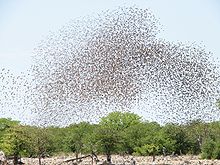
While some birds are essentially territorial or live in small family groups, other birds may form large flocks. The principal benefits of flocking are safety in numbers and increased foraging efficiency. Defence against predators is particularly important in closed habitats like forests, where ambush predation is common and multiple eyes can provide a valuable early warning system. This has led to the development of many mixed-species feeding flocks, which are usually composed of small numbers of many species; these flocks provide safety in numbers but reduce potential competition for resources. Costs of flocking include bullying of socially subordinate birds by more dominant birds and the reduction of feeding efficiency in certain cases.
Birds sometimes also form associations with non-avian species. Plunge-diving seabirds associate with dolphins and tuna, which push shoaling fish towards the surface. Hornbills have a mutualistic relationship with Dwarf Mongooses, in which they forage together and warn each other of nearby birds of prey and other predators.

Communication

Birds communicate using primarily visual and auditory signals. Signals can be interspecific (between species) and intraspecific (within species).
Birds sometimes use plumage to assess and assert social dominance, to display breeding condition in sexually selected species, or to make threatening displays, as in the Sunbittern's mimicry of a large predator to ward off hawks and protect young chicks. Variation in plumage also allows for the identification of birds, particularly between species. Visual communication among birds may also involve ritualised displays, which have developed from non-signalling actions such as preening, the adjustments of feather position, pecking, or other behaviour. These displays may signal aggression or submission or may contribute to the formation of pair-bonds. The most elaborate displays occur during courtship, where "dances" are often formed from complex combinations of many possible component movements; males' breeding success may depend on the quality of such displays.

Bird calls and songs, which are produced in the syrinx, are the major means by which birds communicate with sound. This communication can be very complex; some species can operate the two sides of the syrinx independently, allowing the simultaneous production of two different songs. Calls are used for a variety of purposes, including mate attraction, evaluation of potential mates, bond formation, the claiming and maintenance of territories, the identification of other individuals (such as when parents look for chicks in colonies or when mates reunite at the start of breeding season), and the warning of other birds of potential predators, sometimes with specific information about the nature of the threat. Some birds also use mechanical sounds for auditory communication. The Coenocorypha snipes of New Zealand drive air through their feathers, woodpeckers drum territorially,and Palm Cockatoos use tools to drum.

Migration

Many bird species migrate to take advantage of global differences of seasonal temperatures, therefore optimising availability of food sources and breeding habitat. These migrations vary among the different groups. Many landbirds, shorebirds, and waterbirds undertake annual long distance migrations, usually triggered by the length of daylight as well as weather conditions. These birds are characterised by a breeding season spent in the temperate or arctic/antarctic regions and a non-breeding season in the tropical regions or opposite hemisphere. Before migration, birds substantially increase body fats and reserves and reduce the size of some of their organs.Migration is highly demanding energetically, particularly as birds need to cross deserts and oceans without refuelling. Landbirds have a flight range of around 2,500 km (1,600 mi) and shorebirds can fly up to 4,000 km (2,500 mi), although the Bar-tailed Godwit is capable of non-stop flights of up to 10,200 km (6,300 mi). Seabirds also undertake long migrations, the longest annual migration being those of Sooty Shearwaters, which nest in New Zealand and Chile and spend the northern summer feeding in the North Pacific off Japan, Alaska and California, an annual round trip of 64,000 km (39,800 mi).Other seabirds disperse after breeding, travelling widely but having no set migration route. Albatrosses nesting in the Southern Ocean often undertake circumpolar trips between breeding seasons.

Some bird species undertake shorter migrations, travelling only as far as is required to avoid bad weather or obtain food. Irruptive species such as the boreal finches are one such group and can commonly be found at a location in one year and absent the next. This type of migration is normally associated with food availability.Species may also travel shorter distances over part of their range, with individuals from higher latitudes travelling into the existing range of conspecifics; others undertake partial migrations, where only a fraction of the population, usually females and subdominant males, migrates.Partial migration can form a large percentage of the migration behaviour of birds in some regions; in Australia, surveys found that 44% of non-passerine birds and 32% of passerines were partially migratory.Altitudinal migration is a form of short distance migration in which birds spend the breeding season at higher altitudes elevations and move to lower ones during suboptimal conditions. It is most often triggered by temperature changes and usually occurs when the normal territories also become inhospitable due to lack of food.Some species may also be nomadic, holding no fixed territory and moving according to weather and food availability. Parrots as a family are overwhelmingly neither migratory nor sedentary but considered to either be dispersive, irruptive, nomadic or undertake small and irregular migrations. The ability of birds to return to precise locations across vast distances has been known for some time; in an experiment conducted in the 1950s a Manx Shearwater released in Boston returned to its colony in Skomer, Wales, within 13 days, a distance of 5,150 km (3,200 mi). Birds navigate during migration using a variety of methods. For diurnal migrants, the sun is used to navigate by day, and a stellar compass is used at night. Birds that use the sun compensate for the changing position of the sun during the day by the use of an internal clock. Orientation with the stellar compass depends on the position of the constellations surrounding Polaris. These are backed up in some species by their ability to sense the Earth's geomagnetism through specialised photoreceptors

Wednesday, January 5, 2011

Flight

Most birds can fly, which distinguishes them from almost all other vertebrate classes. Flight is the primary means of locomotion for most bird species and is used for breeding, feeding, and predator avoidance and escape. Birds have various adaptations for flight, including a lightweight skeleton, two large flight muscles, the pectoralis (which accounts for 15% of the total mass of the bird) and the supracoracoideus, as well as a modified forelimb (wing) that serves as an aerofoil.Wing shape and size generally determine a bird species' type of flight; many birds combine powered, flapping flight with less energy-intensive soaring flight. About 60 extant bird species are flightless, as were many extinct birds. Flightlessness often arises in birds on isolated islands, probably due to limited resources and the absence of land predators.Though flightless, penguins use similar musculature and movements to "fly" through the water, as do auks, shearwaters and dippers.